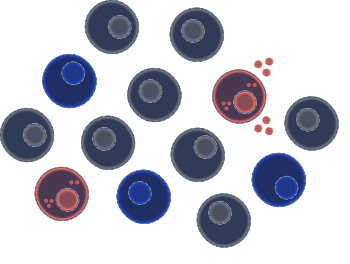
SCIENCE BEHIND ARPELOS

SCIENCE BEHIND ARPELOS

Single-cell resolution that reveals what standard models miss


Problem

Preclinical tools can’t keep up with biological complexity

Even the most advanced drugs can fail—not because they miss the target, but because they behave unpredictably across different cell types.

This challenge, known as therapeutic pleiotropism, is rarely captured by traditional assays. Drugs interact with complex cellular systems, often activating one population while suppressing another. The outcome? Conflicting effects that standard models struggle to predict.

What we don’t measure, we can’t control

We realized that the most accessible and information-rich source of human biology—blood—was being underused. So we started with a simple idea: what if you could treat fresh human blood like a full-body sensor? By analyzing responses across all major blood cell types in parallel, we could start to see not just what a drug was designed to do, but what it actually does.

Dr. Lina Kovach

Arpelos Founder

“Too many drugs fail because we can’t see why.”

What we don’t measure, we can’t control

What began as a proof-of-concept evolved into a robust, scalable platform for capturing complex drug behavior in a format pharma teams can act on. Today, we’re combining single-cell resolution with functional profiling to bring clarity to one of the hardest problems in drug development—how to understand, predict, and design around therapeutic pleiotropism.

Tetraspecific 3+1 Monovalent, VHH (3)

fig.01

Tetraspecific 3+1 Monovalent, VHH (3)

fig.01

Tetraspecific 3+1 Monovalent, VHH (3)

fig.01

Our Approach

We use blood to map drug effects in detail

Step 2

Our approach

Expose, observe, decode.

Compounds are introduced under tightly controlled ex vivo conditions, preserving cellular diversity and interaction.
We use a combination of single-cell technologies and functional assays to measure how each individual cell responds—across thousands of parallel data points. This includes changes in gene expression, cytokine secretion, surface markers, and metabolic state.

Step 1

Our approach

Start with blood. Keep it real.

We begin with fresh human blood, which contains a rich and clinically relevant mixture of immune, progenitor, and hematopoietic cells. These cells aren’t genetically engineered or isolated in artificial environments—they’re intact, functioning, and full of variability, just like in a real patient. This gives us a powerful foundation to study how drugs interact with the full immune landscape in its native form.

Step 2

Our approach

Expose, observe, decode.

Compounds are introduced under tightly controlled ex vivo conditions, preserving cellular diversity and interaction.
We use a combination of single-cell technologies and functional assays to measure how each individual cell responds—across thousands of parallel data points. This includes changes in gene expression, cytokine secretion, surface markers, and metabolic state.

Step 3

Our approach

Inflammatory CD8+ T cell

Tfh/Tph CD4+ T cell

Bystander

T cell

B cell

From complexity to clarity.

We integrate these data into high-dimensional profiles that reveal a drug’s full cellular fingerprint. This systems-level insight helps researchers identify both desired effects and unexpected liabilities early in the pipeline—long before costly in vivo studies or clinical trials. The result is a deeper understanding of therapeutic potential, and a more rational,
data-driven path forward.

Our Approach

We use blood to map drug effects in detail

From fresh blood to functional insight
in days, not months

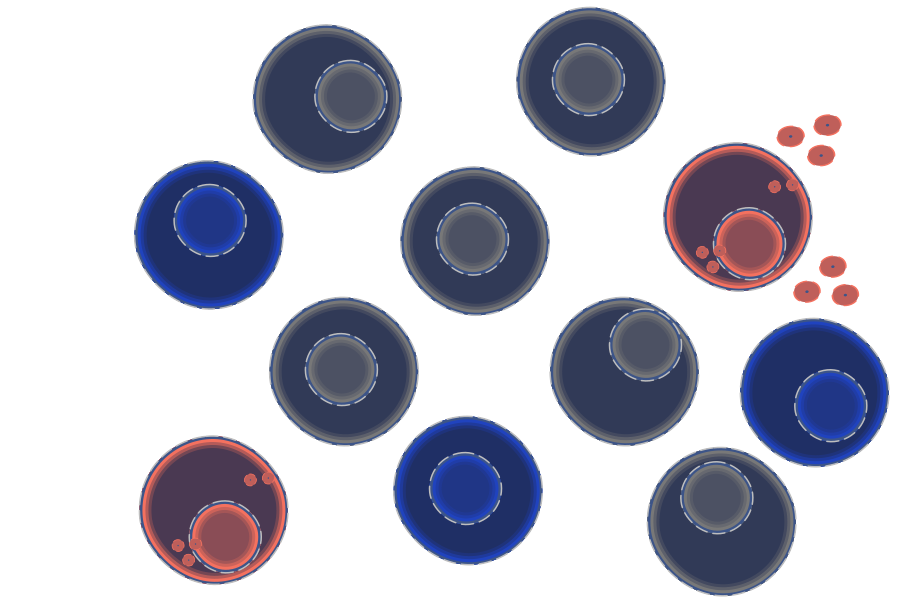
We turn fresh human blood into a living model for drug respons —capturing how diverse cell types react in parallel. Our rapid, high-resolution workflow delivers functional readouts and cellular profiles in just days, helping teams move faster with more confidence.
From fresh blood to functional insight
in days, not months

We turn fresh human blood into a living model for drug respons —capturing how diverse cell types react in parallel. Our rapid, high-resolution workflow delivers functional readouts and cellular profiles in just days, helping teams move faster with more confidence.

Our Pipeline

How we work

Step 1

01/

Blood Collection

We source fresh, non-manipulated human blood under IRB-approved protocols—ensuring real biological relevance.

Step 2

02/

Single-Cell Profiling

Test compounds are introduced ex vivo to preserve cell diversity and native function.

Step 3

03/

Single-Cell Profiling

High-resolution measurements of gene expression, surface markers, and functional states across thousands of individual cells.

Step 4

04/

Functional Assays

Cytokine release, metabolic stress, and phenotypic changes captured in parallel for system-wide insight.

Step 5

05/

Data Integration & Readout

We synthesize cellular and functional data into clear, interpretable profiles that highlight pleiotropic effects and help guide next steps.

Our Pipeline

How we work

Step 1

01/

Blood Collection

We source fresh, non-manipulated human blood under IRB-approved protocols—ensuring real biological relevance.

Step 2

02/

Single-Cell Profiling

Test compounds are introduced ex vivo to preserve cell diversity and native function.

Step 3

03/

Single-Cell Profiling

High-resolution measurements of gene expression, surface markers, and functional states across thousands of individual cells.

Step 4

04/

Functional Assays

Cytokine release, metabolic stress, and phenotypic changes captured in parallel for system-wide insight.

Step 5

05/

Data Integration & Readout

We synthesize cellular and functional data into clear, interpretable profiles that highlight pleiotropic effects and help guide next steps.

Our Pipeline

How we work

Step 1

01/

Blood Collection

We source fresh, non-manipulated human blood under IRB-approved protocols—ensuring real biological relevance.

Step 2

02/

Single-Cell Profiling

Test compounds are introduced ex vivo to preserve cell diversity and native function.

Step 3

03/

Single-Cell Profiling

High-resolution measurements of gene expression, surface markers, and functional states across thousands of individual cells.

Step 4

04/

Functional Assays

Cytokine release, metabolic stress, and phenotypic changes captured in parallel for system-wide insight.

Step 5

05/

Data Integration & Readout

We synthesize cellular and functional data into clear, interpretable profiles that highlight pleiotropic effects and help guide next steps.

Partnering

Let’s make your compounds more predictable.

We work with drug developers to profile preclinical candidates, de-risk discovery programs, and uncover new mechanisms of action. Whether you're advancing an early-stage biologic or optimizing a lead, we help you see what standard assays can’t.

Who we work with

We partner with R&D teams at global pharma companies, emerging biotechs, and translational researchers looking to deepen their understanding of drug behavior. 

R&D teams at global pharma companies

Emerging biotechs exploring new therapeutic platforms

Translational researchers focused on immune or blood-based mechanisms

Preclinical groups seeking deeper mechanistic or safety insights

Flexible, collaborative, built for real-world questions

We work closely with partners to tailor each study—from early exploratory screens to targeted mechanistic programs. Our team brings both scientific depth and operational agility, making it easy to plug into your pipeline. Whether you’re de-risking a candidate or uncovering new opportunities, we’re here to help you move with clarity.

Contact us to learn more
STAY IN THE LOOP

Stay in the loop
as we build
what's next

Get occasional updates on our research, progress, and partnerships — no noise, just meaningful news from the Arpelos team.

Your email adress…

Sign up

Sign up

Advancing drug discovery through high-resolution insights into human blood biology. Powered by science, driven by impact.

© 2025 Arpelos. All Rights Reserved.

Terms and Conditions

Privacy Policy

Trademarks

Create a free website with Framer, the website builder loved by startups, designers and agencies.